Selecting the Right Urology Equipment Partner for Hospitals and Distributors

Urology Equipment Manufacturer in India – Advanced Solutions for Modern Urology
19/08/2026
Advin Urology: Expanding Access to Advanced Urology Equipment from India
21/08/2026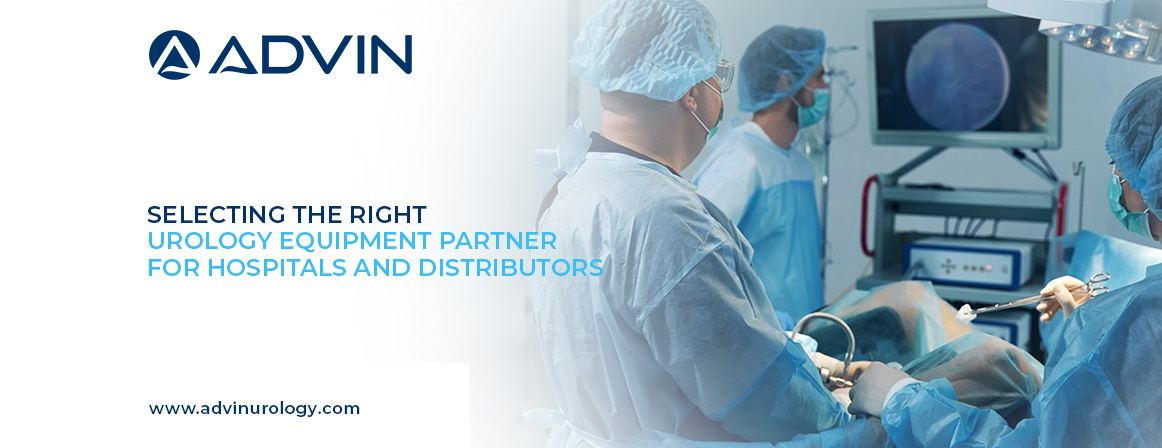
Modern urology departments depend on specialized medical equipment to support diagnostic assessment, endoscopic procedures, stone management, laser-based treatment, prostate procedures, and other clinical applications. With healthcare facilities increasingly investing in advanced technology, choosing the right urology equipment manufacturer in India has become an important part of hospital procurement.
For hospitals, urology centers, medical distributors, and healthcare procurement teams, the right manufacturer should offer more than individual products. Product quality, technology, portfolio diversity, technical capabilities, documentation, supply reliability, and long-term support should all be considered before establishing a supplier relationship.
Why Choosing the Right Manufacturer Matters
Urology equipment can become an important part of a hospital’s operating-room and diagnostic infrastructure. Different procedures may require different technologies, and several systems may need to work together within the same clinical environment.
A healthcare buyer therefore needs to assess the manufacturer behind the equipment rather than comparing products only by their initial price.
A reliable manufacturer can help provide:
- Consistent product quality
- Appropriate technological solutions
- Multiple equipment categories
- Product and technical documentation
- Supply support
- Communication with procurement teams
- Long-term business coordination
These factors can become especially important when a hospital is expanding its urology department or when a distributor needs a dependable source for multiple product categories.
Look Beyond the Product Price
Price is naturally an important consideration in medical procurement, but it should not be the only deciding factor.
A lower initial purchase price may not necessarily represent better long-term value if equipment has limited compatibility, insufficient documentation, difficult maintenance requirements, or inconsistent availability of related components.
Buyers should instead consider the complete value of the equipment, including its intended application, specifications, usability, compatibility, technical support, and expected operational requirements.
For international buyers, export documentation, packaging, shipping coordination, and communication with the manufacturer may also influence the overall procurement experience.
Evaluate the Manufacturer’s Product Portfolio
A broad product portfolio can indicate a manufacturer’s ability to serve different requirements within the same medical specialty.
In urology, equipment requirements can extend across several technology areas, including electrosurgery, TURP, lithotripsy, laser systems, endoscopy, irrigation, uroflowmetry, imaging, and prostate tissue management.
Advin Urology offers a range that includes products such as Bipolar Saline TURP Generators, Electrosurgical Units, Advanced Pneumatic Lithotripters, Wireless Uroflowmetry Systems, LED Light Sources, Uro Irrigation Pumps, Thulium Laser Machines, Holmium Laser Machines, Urology C-Arm Machines, Prostate Morcellator Devices, and HD Endoscopy Cameras.
A diversified range allows buyers to evaluate different equipment requirements through a broader medical device portfolio.
Consider Technology and Clinical Requirements
Urology continues to adopt minimally invasive and technology-assisted procedures. Equipment manufacturers therefore need to provide solutions that correspond with changing clinical requirements.
Laser systems, high-definition visualization, advanced electrosurgical technology, irrigation systems, and modern imaging equipment can all play different roles in contemporary urology.
When reviewing a manufacturer’s portfolio, buyers should consider whether the equipment is appropriate for their intended procedures and whether its specifications support the requirements of the facility.
The focus should be on finding equipment that fits the clinical workflow rather than simply selecting the newest technology available.
Check Compatibility and Integration
Modern urology procedures may involve several pieces of equipment operating together.
An endoscopy setup, for example, can involve an HD camera, LED light source, irrigation system, endoscope, display, and other compatible components. Stone-management procedures may involve visualization systems together with lithotripsy or laser technology.
Because of this, compatibility is an important procurement consideration.
Hospitals should review connections, accessories, intended configurations, and system requirements before finalizing equipment purchases. A manufacturer with a wider portfolio can make it easier to discuss complementary equipment requirements.
Assess Quality and Documentation
Medical equipment should be supported by appropriate product information and documentation.
Before purchasing, procurement teams can review technical specifications, applicable quality information, regulatory documentation, operating requirements, and other relevant materials.
It is also useful to understand how the manufacturer approaches quality control and product consistency.
For distributors and importers, clear documentation can be particularly important when products are being supplied into different healthcare markets with their own regulatory and procurement requirements.
Technical Support and Long-Term Supply
The relationship with a medical equipment manufacturer does not necessarily end after the purchase.
Hospitals may require technical assistance, maintenance support, replacement components, accessories, or additional equipment as their departments grow. Distributors may also need consistent product availability to support their customers.
For this reason, buyers should consider the manufacturer’s ability to provide ongoing communication and supply support.
A manufacturer that can support recurring procurement requirements can become a more practical long-term partner than a supplier focused only on individual transactions.
Why Advin Urology Can Be Considered for Urology Equipment Requirements
Advin Urology focuses on urological products and equipment designed to address different requirements of modern urology departments.
Its portfolio covers several equipment areas, including electrosurgical technology, TURP systems, lithotripsy, laser systems, endoscopy, irrigation, uroflowmetry, imaging, and prostate tissue management.
This product diversity enables hospitals, urology centers, distributors, and healthcare procurement organizations to explore multiple equipment requirements through a specialized urology-focused manufacturer and supplier.
For buyers, working with a supplier that understands the broader urology equipment environment can also simplify communication when multiple product categories are required.
Making a Confident Urology Equipment Procurement Decision
Choosing a urology equipment manufacturer should involve a broader assessment than product specifications and purchase price alone. Buyers should look at the manufacturer’s portfolio, product quality, technology, compatibility, documentation, supply capabilities, technical support, and ability to meet future requirements.
A well-established supplier relationship can make procurement more consistent while helping healthcare facilities access equipment suited to their evolving urology services.
A Reliable Approach to Urology Equipment Procurement
The right urology equipment partner should combine suitable technology with dependable products, clear communication, a comprehensive portfolio, and the ability to support healthcare buyers over the long term.
For hospitals, distributors, and international medical-device buyers, evaluating these factors can make the procurement process more informed and practical. Advin Urology provides a focused range of urology equipment and solutions for healthcare organizations seeking specialized products from an India-based medical device manufacturer and supplier.